Why ERP and CRM Are Essential for Businesses in Saudi Arabia's Competitive Market
Introduction
The business landscape in Saudi Arabia is becoming increasingly competitive across many industries. Companies are expected to operate efficiently, provide high-quality customer service, and maintain accurate operational records at the same time. When businesses rely on separate software tools and manual workflows, it often leads to delays, inconsistencies, and operational mistakes.
To overcome these challenges and stay organized, many organizations are moving toward integrated digital technologies. Two of the most widely adopted platforms are ERP and CRM. These systems allow companies to manage internal processes and customer relationships more effectively by using centralized and reliable business information.
Modern organizations are also adopting real-time vehicle tracking technologies to strengthen logistics management, fleet monitoring, and operational visibility.
How ERP Supports Internal Business Control
ERP platforms bring several core operational activities into one coordinated environment. Financial management, employee information, purchasing activities, and inventory tracking can all be managed within a single platform rather than through multiple disconnected systems. This approach helps maintain consistency and eliminates duplicate data entry across departments.
With Enterprise Resource Planning (ERP) systems, managers gain access to live operational data that allows them to review financial performance, monitor resource usage, and evaluate costs more efficiently. Instead of waiting for manually prepared reports, decision-makers can rely on real-time insights to guide planning and business strategy. Organizations that operate delivery fleets can also integrate ERP with GPS tracking technologies to monitor vehicle movements and improve route efficiency.
How CRM Strengthens Customer-Facing Activities
While ERP focuses mainly on internal operations, CRM systems concentrate on managing customer interactions and sales activities. These platforms record communication history, track sales opportunities, and organize follow-up actions so teams can maintain consistent engagement with customers.
Sales and marketing teams benefit from having clear visibility of each opportunity in the pipeline and can quickly determine the next steps required. By maintaining structured customer records, response times improve and relationship management becomes more professional and organized.
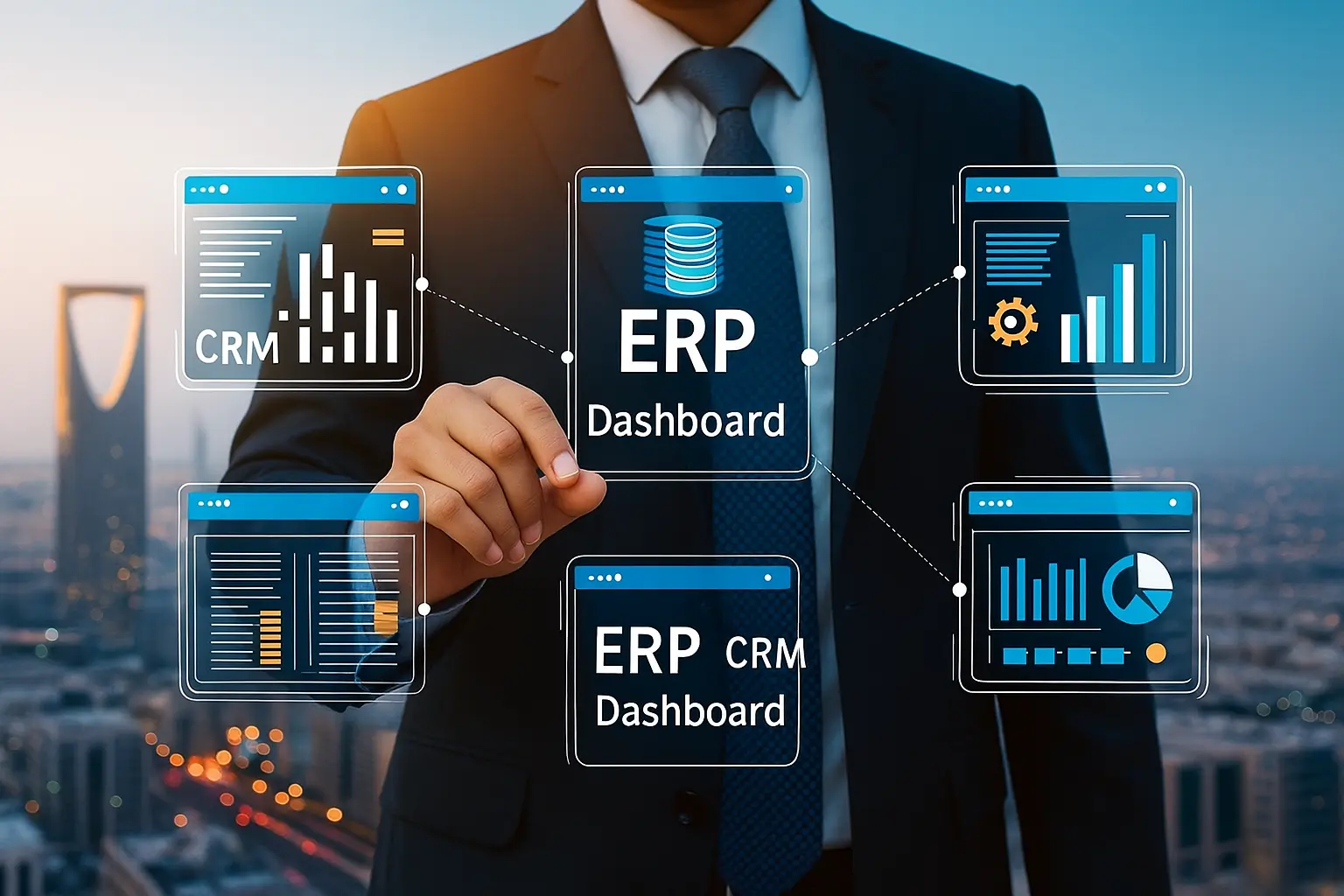
When implemented together, ERP and CRM systems help organizations connect customer information with operational processes, improving service delivery and coordination across departments.
Why These Systems Matter in Saudi Arabia
Saudi Arabia is undergoing rapid economic development supported by strong digital transformation initiatives. As businesses grow and transaction volumes increase, companies need better tools to maintain control over operations and comply with regulatory requirements.
Many organizations are now adopting ERP and CRM systems in Saudi Arabia to manage documentation, approval workflows, and financial records more efficiently. These systems often support Arabic interfaces and local business standards, making them suitable for organizations operating in the regional market. Companies managing logistics operations can also benefit from integrating vehicle monitoring solutions to improve route planning and operational oversight.
Combined Value of ERP and CRM
When ERP and CRM operate as a single environment, departments can access shared information instead of working with isolated data. For example, when a sales order is confirmed in CRM, the same data can automatically update billing, accounting, and inventory records inside ERP.
This integration eliminates the need for repeated manual coordination and reduces the risk of data mismatches. As a result, organizations experience more efficient workflows, stronger financial control, and improved customer service.
Businesses implementing ERP and CRM solutions can create a connected operational environment where customer activities and internal processes work together seamlessly.
Our ERP and CRM Implementation Approach
Successful system implementation begins with understanding how a business currently operates. Our process starts with reviewing existing workflows and identifying areas where operational improvements are needed. Based on this evaluation, we configure the system environment so that it reflects real business processes rather than forcing generic templates.
Our team deploys ERP platforms, prepares structured data imports, and integrates required third-party services. Companies may choose cloud-based infrastructure or on-premise hosting depending on their operational preferences. After deployment, we provide user training and continuous technical support to ensure smooth system adoption.
Tailoring the System to Each Organization
Every organization has unique operational procedures, approval requirements, and reporting structures. For this reason, system configuration must reflect the specific needs of each business.
We adjust user roles, dashboards, document formats, and reporting structures so that employees can easily navigate the platform. Clear layouts and simplified interfaces help teams adopt the system faster and integrate it into their daily work routines.
The Role of Automation
Operational efficiency can be greatly improved through automation. Built-in workflow automation allows repetitive activities to run automatically without constant manual intervention.
Examples include recurring invoices, salary processing, purchase approvals, and automated reminders for pending tasks. Automation reduces the possibility of human error while ensuring that processes are completed consistently across departments.
Organizations that implement ERP and CRM systems benefit from faster processing times and more reliable operational workflows.
Functional Areas Typically Covered
ERP and CRM environments usually support a wide range of business activities, including:
Financial monitoring and expense management:
Inventory tracking and warehouse visibility:
Procurement processes and sales order management:
Production scheduling and operational planning:
Employee records and payroll administration:
Project tracking and service management:
Lead management and customer communication:
Integration with messaging platforms and payment tools:
Why Many Saudi Companies Work With Us
Organizations operating in Saudi Arabia often require both technical expertise and familiarity with regional compliance standards. Our approach focuses on guiding businesses through each stage of system implementation to ensure smooth adoption.
We assist companies with system configuration, employee training sessions, and long-term support services. This helps organizations achieve operational benefits more quickly while minimizing disruption during the transition period.
Businesses that adopt integrated digital platforms early often gain a competitive advantage as they scale operations and respond more effectively to changing market demands.
Conclusion
For companies operating in Saudi Arabia's evolving business environment, digital integration has become a key requirement for sustainable growth. By implementing ERP and CRM solutions, organizations can connect internal operations with customer management in a single unified platform.
This integration improves operational visibility, strengthens process control, and enhances customer service capabilities. As businesses continue to expand, adopting integrated management systems will remain essential for maintaining efficiency and long-term competitiveness.